Youth Daily · Youth Shanghai reporter Yang Lijia / Text, Shi Jianping / Photos, Video
After the F1 Chinese Grand Prix concluded, the racing carnival in China continued. As a top international new energy racing event, Formula E returned to China after a five-year absence. The Formula E World Championship Shanghai round took place this weekend at the Shanghai International Circuit. The key difference between FE and F1 lies in the power source – F1 cars use internal combustion engines powered by gasoline; FE cars replace the fuel tank with a battery, running purely on electric energy, representing the future trends and cutting-edge technologies of automobiles. In Anting Town, there is such a group of wind-chasing youths who harness electricity and chase light, zooming on the Formula Student electric track from building cars to racing them. They are DIAN Racing.
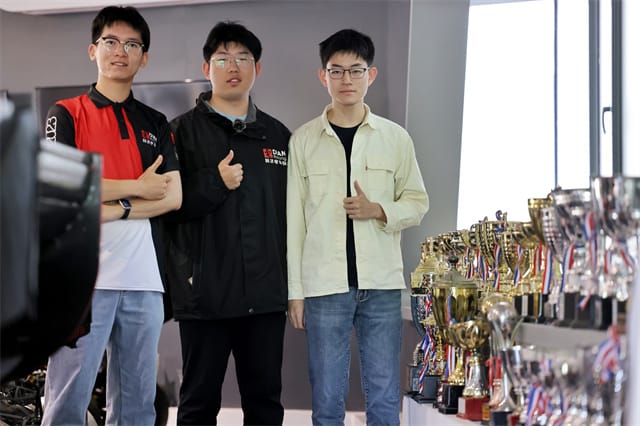
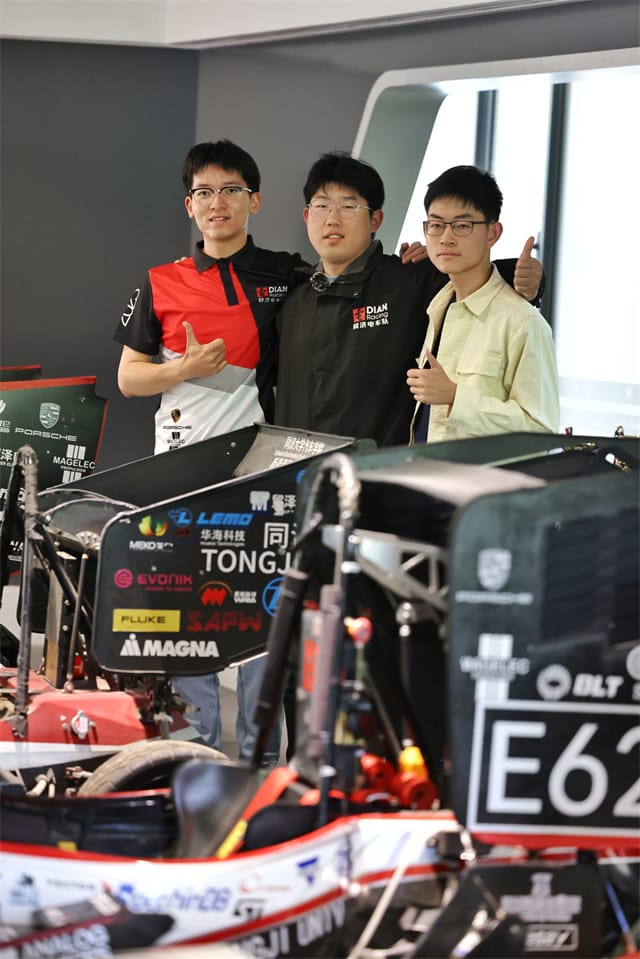
Huang Zihao, Zhao Yuanzheng, and Guo Junchao (from left to right).
Self-Built: The Birth of an FE Race Car
This is a workshop converted from a shipping container. Though it’s only about 100 square meters, brand-new race cars are born and set off from here.
Upon entering, several key members are laying carbon fiber cloth around a bare chassis. What seems like simple work involves great intricacy. Beside it stands a small blackboard densely covered with notes on laying carbon fiber – meticulous to the last detail, akin to embroidery. Don’t underestimate this still-rough semi-finished product; it is exactly DRe24, which will compete this September in the highest-level Asian Formula Student competition: the Student Formula Japan.
“From early steel tube frames to carbon fiber monocoques, the body weight has been halved. We need to lay a total of five layers of carbon fiber cloth, and the entire process must be completed before the end of May. So we’ve arranged four shifts from 8 a.m. to 11 p.m., with 12 members rotating,” explains Zhao Yuanzheng, captain of DIAN Racing for the 2024 season. Founded in 2013, DIAN Racing mainly consists of undergraduate students. Each year they independently design and build a race car, named DRe plus the current year. The team currently has 86 members from the School of Automotive Studies, the School of Electronics and Information Engineering, the School of Mechanical and Energy Engineering, the School of Arts and Media, and the School of Economics and Management. Based on their professional strengths, they form the technical department, management department, and business department. Over 11 years, the team has achieved many “firsts” – China’s first dual-motor team, first four-motor team, first team to build its own battery box and battery management system, first four-wheel-drive team with a complete dynamic control algorithm, first team to build its own vehicle control unit, and more.
“Most of us joined the team in our sophomore year. Back then we never imagined that witnessing the birth of a race car would require investing almost all of our spare time – from conceptual design to modeling and simulation, software design, manufacturing parts, assembling the vehicle, and finally track testing… Especially before competitions, every second counts, and working through the night is routine,” says team captain Guo Junchao.
Adhering to the philosophy of “lighter, faster, more stable,” each year’s new car sees performance improvements of varying degrees. Take last year’s DRe23, for example. It used metal 3D-printed suspension rockers, wheel uprights, cooling water jackets, and other parts – as a product of generative design, this was a first in the Formula Student Electric China competition. Additionally, Guo Junchao led the team to optimize the aerodynamics package, including a newly designed monocoque, side wings, and rear wing, which not only achieved lightweighting but also provided greater downforce, ensuring better cornering performance and making the car more stable and agile on track. In his view, the hardest part of Formula Student electric cars is stability – motor errors, safety circuit disconnections, insulation anomalies… such problems often crop up unexpectedly. This requires great precision in every detail like electrical connections and software coordination; the slightest slip can lead to total failure. Electric vehicles are still in their early stages, and during the car-building process, surprises are the norm rather than the exception. Along with technological innovation come countless design improvements or even starting over from scratch. To meet deadlines and compete, the team’s schedule is packed full, and members rarely go home even during winter and summer breaks – car building starts in winter break, and summer break is for testing. Even so, no one complains; everyone finds joy in it.
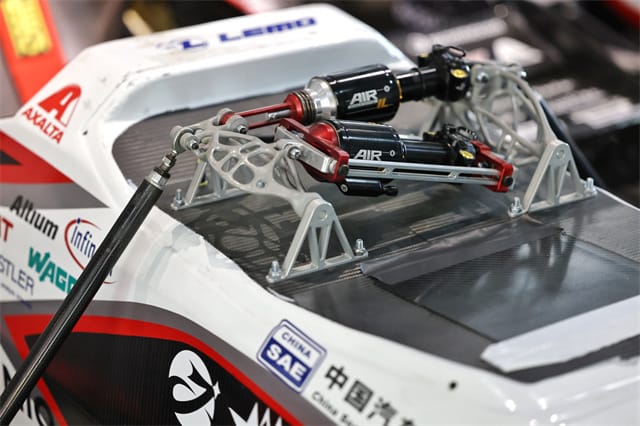
When discussing the highlights of this year’s DRe24, Guo Junchao says the team’s first self-built inverter will soon be “onboard”: “The Formula Student electric powertrain ‘trinity’ consists of the battery, motor, and inverter. As early as 2019, the then-captain proposed developing our own inverter, because relying on external support would hinder future innovation. After five years of continuous effort, we can finally achieve it this year. The trials and tribulations over these years have made me realize more deeply that technological innovation requires not only passion but also patience and steady persistence.”
Motor Whine: FE Cars Are Also “Fire”
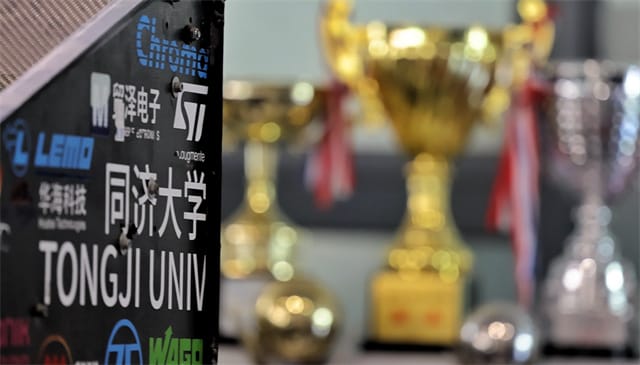
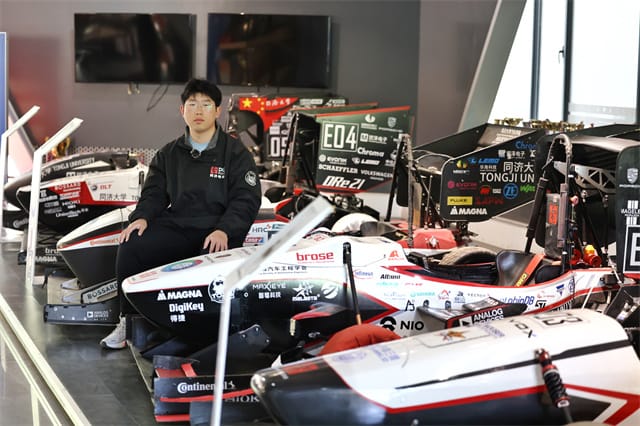
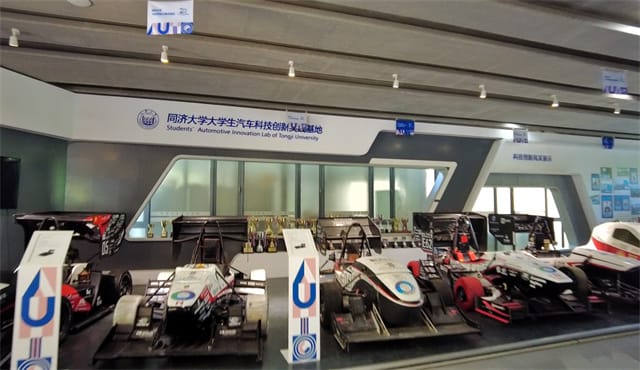
Following that, the reporter visited Tongji University’s Student Automotive Technology Innovation Practice Base, where several previous years’ race cars were lined up, an impressive sight. “This is DRe18, which won first place for Best Battery Box Design at the 2018 Student Formula Japan; this is DRe20, which won the championship at the 2020 Formula Student Electric China; this is DRe23…” Zhao Yuanzheng rattles them off like treasures.
On the front hood of DRe23, the reporter spotted the signature of Ye Yifei, then-official driver of Porsche Asia Pacific Motorsport. It turned out that last autumn, Porsche China invited DIAN Racing for a friendly match: 718 GT4 RS versus DRe23, and the signature was left right after the race. Driving DRe23 in that race was Huang Zihao, leader of the driver group.
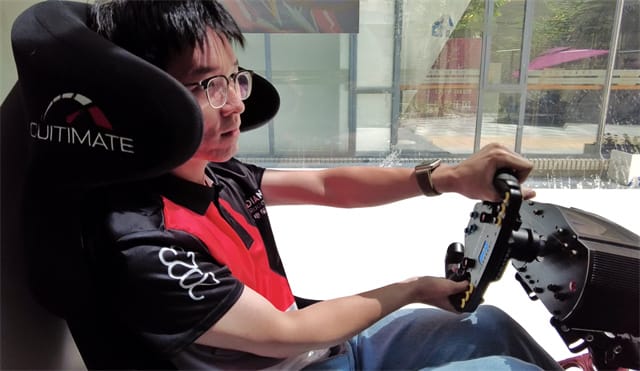
“As soon as the signal flag dropped, the roar of the engine and the whine of the motor burst forth, like two beasts charging down the track,” Huang Zihao still gets excited recalling it. “In the high-speed autocross event, the 718 GT4 RS displayed beautiful cornering lines, while DRe23, with its compact and agile advantages, navigated the track effortlessly and even had a slight edge. Our Formula Student electric car’s 0–100 km/h acceleration is faster than most production electric vehicles on the market – we are quite proud of that.”
This bespectacled senior student, who looks quite bookish, not only trained hard in driving skills to become a racing driver but also became a fitness enthusiast. “Formula cars have no power assistance; especially in endurance races, a driver’s concentration and physical strength are severely tested,” Huang Zihao explains. At last month’s 2024 F1 Chinese Grand Prix, he even served as a scrutineering volunteer. “In the past, I could only watch F1 broadcasts on TV. Now, being able to participate right at my ‘doorstep’ feels like a dream come true. This experience also gave me a new understanding of racing: drivers are often the focus of racing events, but behind the scenes, countless staff members work silently. So racing ultimately reflects the power of the team, what we call ‘team spirit’.”
As a university team mainly composed of undergraduates, the membership changes every year with graduation and new enrollments. To better build cohesion, the team continually adjusts its organizational structure. “In the 2023 season, the team created a function-leader system, breaking down barriers between groups and enhancing members’ vehicle-level design ability and all-round skill development. This year, based on the team’s development needs, we expanded the role of function leaders into project leaders,” says Zhao Yuanzheng. “During a season, we set up multiple sub-projects, such as battery assembly, wheel assembly, ergonomics, composite layup design, business activities, etc. According to project needs, we select outstanding core members and appoint project leaders to manage progress. For technical inheritance, we have established four technical groups – chassis, body, electronic control, and electrical – plus an operations group (business + management). Members learn corresponding skills and knowledge in their groups. Under the new team structure, a member enters DIAN Racing in a certain role, joins a group to learn knowledge and skills, and cultivates excellent engineering thinking and innovative design methods. During work, they engage in multiple projects and project teams, exercising engineering capabilities, exploring themselves, and breaking through personal limits. They progress through the growth path of probationary member, core member, to key member, and amidst the wave of electrification and intelligentization in the automotive industry, they become the young force for the future of new energy vehicles.”
Link
DIAN Racing, also known as the Tongji University Electric Racing Team, is Tongji University’s Formula Student electric racing team. The team independently designs and builds a Formula Student electric race car each year and participates in the Formula Student series of competitions. Since its official establishment in March 2013, the pursuit of speed and efficiency, along with a concern for the environment, has united over a hundred DIAN Racers with international vision and innovative thinking. DIAN Racing’s mission is to build a world-class racing team, participate in FSAE series events, and create a platform for exchange in the new energy vehicle industry. DIAN Racing is part of the Innovation Base of the School of Automotive Studies at Tongji University, under the guidance of Vice Dean Xiong Lu and Mr. Zhang Zhiming. DIAN Racing focuses on high-specification race car design and manufacturing, efficient project management, and actively participates in Formula Student competitions worldwide, contributing with the university and over 80 corporate sponsors to promote the concept of new energy.
Youth Daily · Youth Shanghai reporter Yang Lijia / Text, Shi Jianping / Photos, Video
Editor: Lu Tianyi
Source: Youth Shanghai News — 24-Hour Youth Daily