Author: Guo Junchao, DIAN Racing, Tongji University
Background
Formula Student (FSAE) is a prestigious international student engineering competition. Each year, student teams from universities around the world design and build a prototype formula racing car meeting FSAE rules, competing in dynamic events and static events such as design judging, engaging in a comprehensive contest in vehicle design, team operations, and more.
Today, FSAE has evolved beyond a global engineering education competition into a “testbed” for cutting-edge automotive technologies. Distributed drive systems, steer-by-wire chassis, active suspensions, and other advanced technologies are applied by participating teams to gain an edge in increasingly fierce competition.
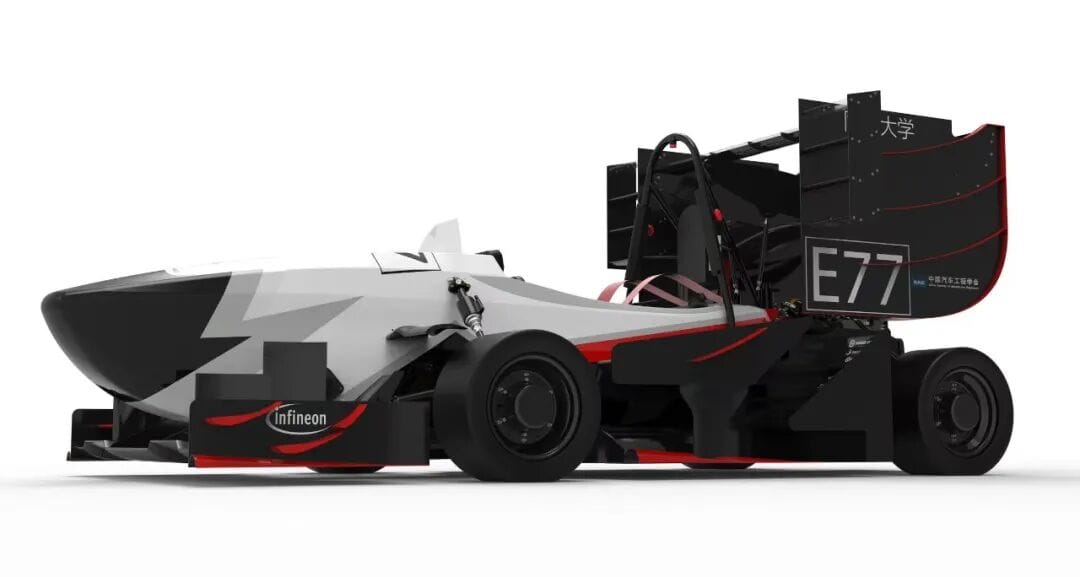
(DIAN Racing DRe23 car)
DIAN Racing, the electric Formula Student team of Tongji University, is one of the oldest FSAE electric vehicle teams in China, consistently at the forefront of technological innovation. Supported by Infineon since 2021, the team’s technical development has been greatly enhanced. This year, with Infineon’s strong support, DIAN Racing designed a new-generation VCU (Vehicle Control Unit) based on the Infineon AURIX™ TC499PP microcontroller, set to be deployed in DRe25 and future cars to meet more intense competition challenges.
Leveraging the powerful computing performance and rich I/O resources of the AURIX™ TC499PP, DIAN Racing built a “super VCU” integrating chassis domain, powertrain domain, and body domain functions, oriented toward a centralized E/E architecture, bringing unlimited possibilities for the team’s technological development in the next five years. This is also the first application of the AURIX™ TC4x in FSAE racing cars, providing a valuable practical case for AURIX™ TC4x in intelligent chassis control, distributed drive control, and other fields.
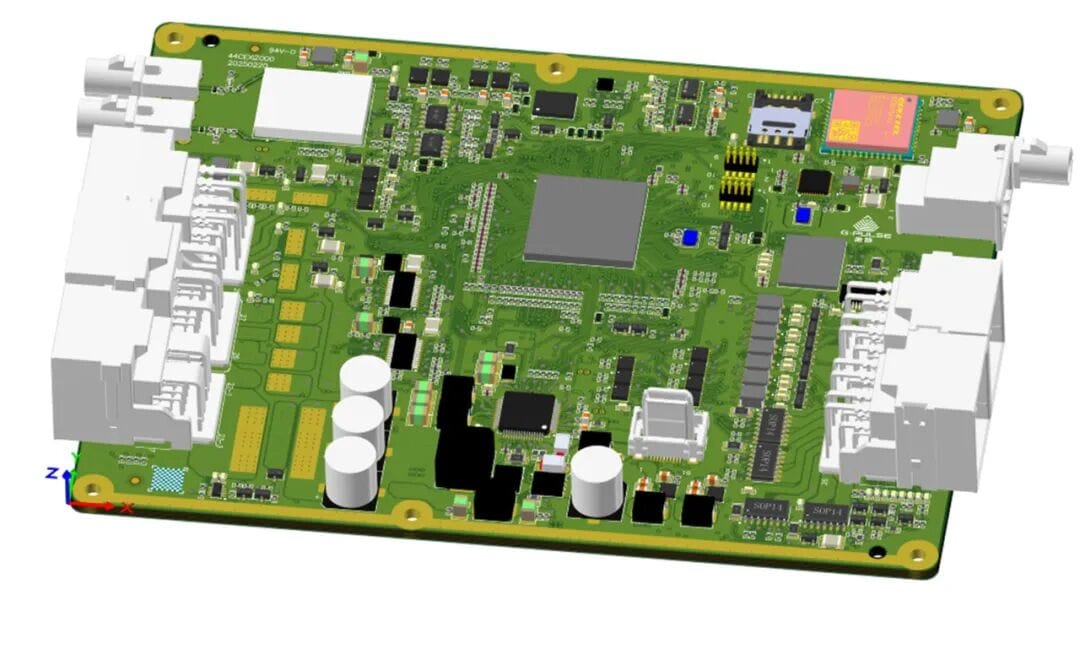
(DIAN Racing’s initial prototype VCU based on AURIX™ TC499PP)
VCU Hardware Design Overview
The AURIX™ TC4x is the latest generation microcontroller from Infineon’s AURIX™ family, suitable for applications such as domain controller and zone controller-based E/E architectures, perfectly meeting the strong demand for functional integration. Among them, the AURIX™ TC49x integrates up to five TriCore™ 1.8 cores and a Parallel Processing Unit (PPU) supporting embedded AI applications. It features richer ADC and GTM timer resources, supporting high-resolution PWM, DS-ADC, etc., particularly suitable for sensor signal acquisition and chassis control scenarios faced by the VCU, making it the core choice for DIAN Racing’s new-generation VCU.
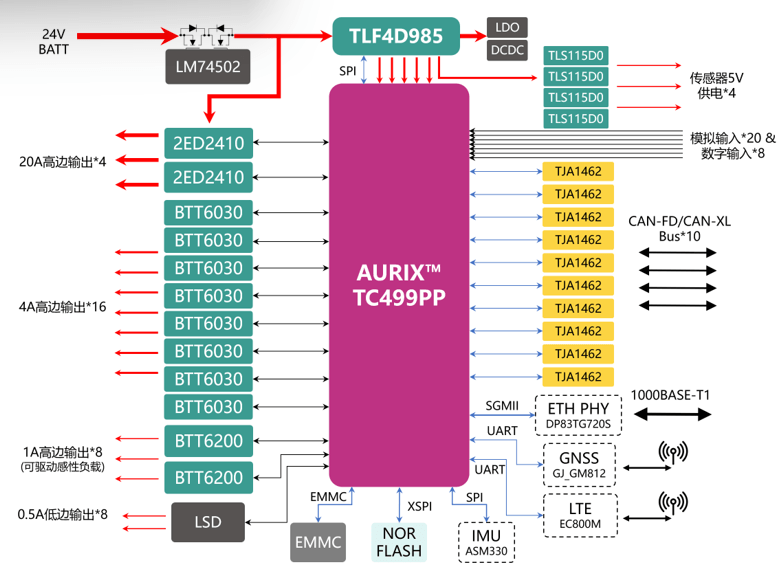
Based on the AURIX™ TC499PP, the VCU hardware designed by DIAN Racing achieves extremely high integration and connectivity. It integrates a large number of intelligent high-side/low-side drivers, CAN transceivers, analog signal acquisition, and other hardware resources, realizing a leap from quantitative to qualitative change. The main hardware features are as follows:
- 20 channels of 0~5V analog signal input
- 8 channels of digital signal input
- 16 channels of high-side driver output with a maximum continuous current of 4A
- 8 channels of high-side driver output with a maximum continuous current of 1A (four channels support inductive loads)
- 4 channels of high-side driver output with a maximum continuous current of 20A
- 8 channels of low-side driver output
- 4 channels of 5V power output (150mA/channel, accuracy ±5mV, used to provide voltage reference for external sensors)
- 10 CAN interfaces (all support CAN-FD, 2 support CAN-XL)
- 1 1000BASE-T1 automotive Ethernet interface
- 8GB eMMC storage
- 1Gbit NOR-FLASH
- Built-in IMU
- Built-in LTE CAT1 mobile communication module
- Built-in GNSS positioning module
Based on the powerful resources of the AURIX™ TC499PP, this VCU integrates multiple traditional controller functions into one, achieving a “quantitative to qualitative change” in hardware, laying a solid hardware foundation for realizing a centralized E/E architecture. The diagram below shows the hardware system block diagram of DIAN Racing’s VCU based on the AURIX™ TC499PP.
VCU Functional Highlights
Leveraging the AURIX™ TC49x’s strong connectivity, performance, and support for virtualization, DIAN Racing’s new-generation VCU integrates more control functions, truly becoming the central hub of vehicle control. It features characteristics of a zone controller and cross-domain fusion controller, capable of undertaking most functions in the powertrain domain, chassis domain, and body domain of an FSAE car. The following highlights some of the functions realized by DIAN Racing’s new VCU.
Vehicle Dynamics Control: DIAN Racing adopts a four-wheel distributed drive system. The VCU uses the built-in IMU and GNSS module to obtain vehicle state, computes and controls the torque of each wheel motor in real time, achieving functions such as virtual limited-slip differential (e-LSD), traction control (TC), torque vectoring (TV), etc.
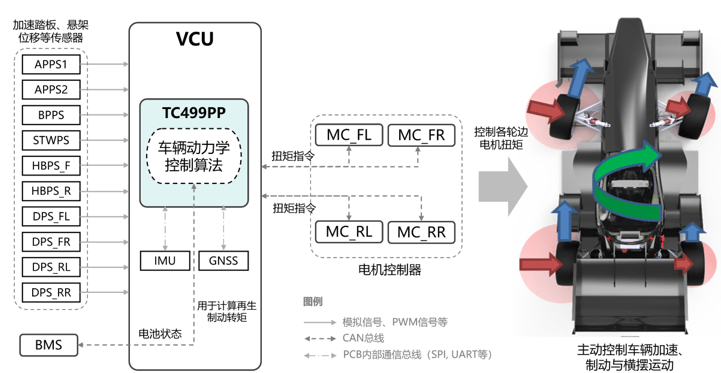
(Vehicle dynamics control system architecture block diagram)
The excellent performance of the new-generation TriCore™ 1.8 core in the AURIX™ TC4x shortens the operation cycle of vehicle dynamics control algorithms from 5ms in previous generations to within 1ms, delivering more agile and precise dynamic control. Additionally, with the Parallel Computing Unit (PPU), the team can run neural network models in the embedded system, enabling machine learning-based vehicle state estimation and dynamic control algorithms, making racing car control smarter and more powerful.
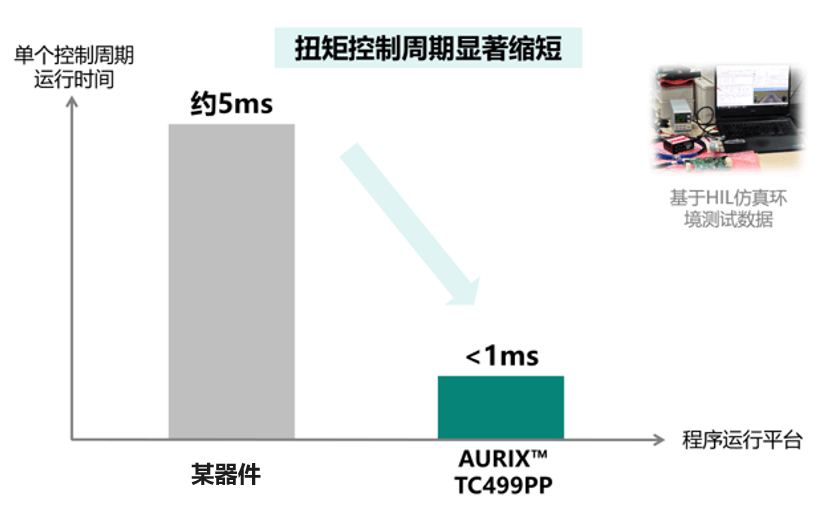
(Torque control cycle comparison)
High Voltage Management: In the new-generation VCU designed by DIAN Racing, high voltage management functions, including battery management and high-voltage power-up/power-down management, are also integrated into the VCU to build a more centralized E/E architecture. The diagram below shows the high voltage management functions implemented in the VCU and its system architecture.
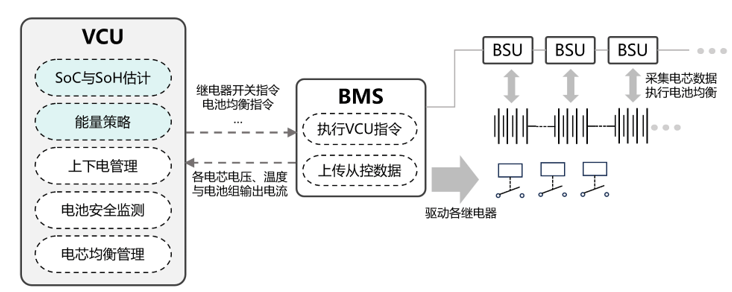
(High voltage management function diagram)
Beyond architecture optimization, the AURIX™ TC4x’s PPU brings powerful AI computing capabilities, enabling smarter battery state estimation (SoC and SoH) and energy strategy management algorithms, effectively improving energy consumption performance, reducing battery weight, and achieving further lightweighting. The AURIX™ TC4x’s good support for virtualization also provides a safer and more convenient platform for porting and integrating high-voltage management software modules.
Vehicle Power Distribution and Low Voltage Management: In today’s automotive electronics, replacing traditional fuses and relays with eFuses and high-side switches has become a major trend, with their high integration, reliability, and safety advantages widely verified. With the abundant ADC and GTM timer resources of the AURIX™ TC499PP, DIAN Racing integrated a sufficient number of intelligent high-side switches into the new VCU, achieving electronification of vehicle low-voltage power distribution.
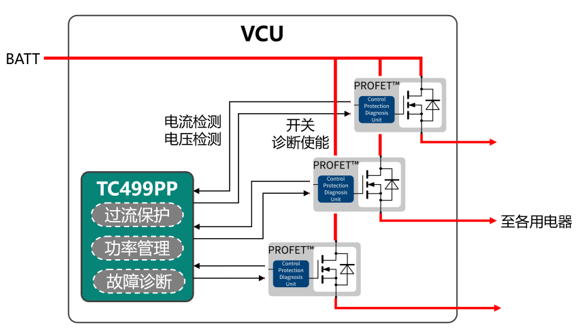
(Vehicle power distribution function diagram)
The new VCU selects Infineon’s 2ED2410, BTT6030, and BTT6200 intelligent high-side switches to meet the needs of different power loads. All high-side drive channels feature diagnostic functions such as current monitoring, short-circuit protection, and over-temperature protection. Combined with the AURIX™ TC499PP’s excellent real-time performance and rich GTM timer resources, advanced functions such as eFuse, soft start, and constant current output can be realized, enabling smarter and more refined control of the low-voltage distribution system.
Vehicle Gateway and Data Acquisition: The VCU is equipped with abundant CAN and Ethernet interfaces. Leveraging the Data Routing Engine (DRE) of the AURIX™ TC4x, it can achieve data routing from CAN to CAN and CAN to Ethernet, fulfilling the vehicle gateway function. With the eMMC5.1 and XSPI interfaces provided by the AURIX™ TC499PP, the new VCU integrates 8GB eMMC and 1Gbit NOR-FLASH storage for recording all sensor and actuator data, providing strong data support for the team to analyze test data and build simulation models.
Furthermore, based on the VCU’s rich high-side/low-side driver interfaces, sensor interfaces, and CAN interfaces, functions such as vehicle thermal management, steer-by-wire control, brake lights, and other indicator light controls required by the competition rules can also be integrated into the VCU, significantly reducing the number of ECUs needed in the vehicle.
Future Outlook
The new-generation VCU designed by DIAN Racing based on the AURIX™ TC499PP brings not only performance and functionality improvements but also a transformation of the FSAE car’s E/E architecture. It integrates all functionally relevant hardware and software modules of the vehicle’s E/E system into a cohesive whole, ending the previous situation where subsystems operated independently.
More importantly, this VCU, which integrates functions from various vehicle systems, essentially introduces a “central nervous system” to the FSAE car, making it possible to install a smarter “brain.” Through the high-speed 1000BASE-T1 Gigabit Ethernet interface, the VCU can interact with high-performance computing platforms. The relationship between the two is akin to the “cerebellum” and “cerebrum”—the VCU directly interacts with the vehicle system, handling execution and real-time control tasks, while the high-computing platform runs neural network models, endowing the FSAE car with intelligence.
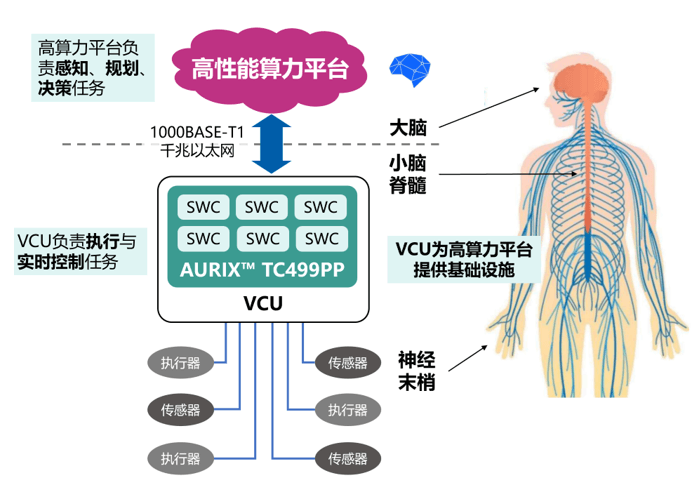
During development, the comprehensive software ecosystem provided by Infineon greatly simplified the team’s software development and testing process. In particular, the Simulink code generation package in the AURIX™ TC4x software ecosystem allows control algorithm developers to directly generate embedded code from control models and perform hardware-in-the-loop testing without dealing with complex underlying software. In the future, the team will continue to leverage this powerful software ecosystem to accelerate upgrade cycles and promote the realization of “software-defined racing cars.”
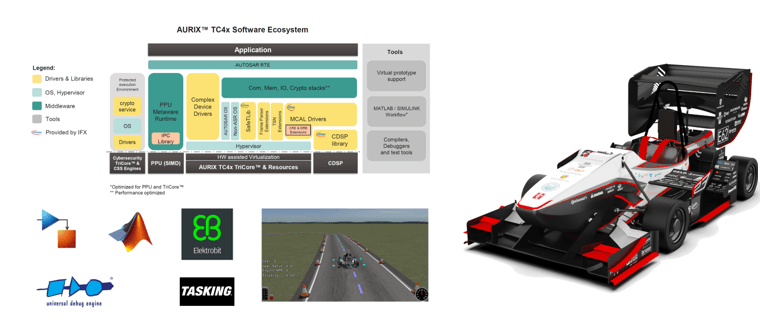
(AURIX TC4x software ecosystem)
Conclusion
With steadfast support from Infineon, DIAN Racing innovatively designed the next-generation FSAE VCU based on the AURIX™ TC499PP, bringing unlimited possibilities for the team’s future technological development. The success of this project also sets a benchmark for university-industry cooperation. During the development of DIAN Racing’s new VCU, Infineon and its partners provided invaluable technical support in hardware design, PCB production, embedded software development, and more, ensuring the successful completion of the VCU project. This innovative practice is not only a leap in DIAN Racing’s technical strength but also a strong testament to the effectiveness of university-industry cooperation in cultivating future automotive talent and driving technological innovation.


Welcome to follow the WeChat official account
Infineon Automotive Electronics Ecosystem