Racing with DIAN Racing | When DolphinDB Big Data Analytics Meets Tongji Electric Racing Team
On the lightning-fast racetrack, every millisecond holds infinite possibilities. Here, data is no longer a cold sequence of numbers but a beating pulse, each beat precisely responding to the race car’s every breath and keenly sensing its dynamics. With the development of IoT and telemetry technologies, real-time collection and analysis of vehicle data have become possible. Compared to ordinary connected vehicle scenarios, a race car’s data governance solution demands not only higher latency and stability but also increasingly diverse requirements for data analysis applications.
DolphinDB has joined hands with Tongji University’s DIAN Racing to bring a racing solution that merges technology and speed, allowing us to appreciate that the battle for every millisecond is both the ultimate pursuit of speed and a profound interpretation of technology. DIAN Racing is a distinguished university-level Formula Student Electric team in China, dedicated to building high-standard Formula Student race cars and efficient project management. The team actively participates in world-class Formula Student competitions and has established a strong reputation in the university Formula Student field both domestically and internationally. Facing the opportunities and challenges of the new era, intelligent electric vehicles represent the team’s technological development direction. To this end, DIAN Racing and DolphinDB have officially established a cooperative relationship. In the future, DolphinDB will maintain close collaboration with DIAN Racing, providing technical support to the electric racing team.
As a preferred solution for collecting, storing, and analyzing real-time streaming data, what specific application scenarios does DolphinDB have in the field of racing?
Data Telemetry
A race car’s data telemetry system is a highly complex technical network that can collect and transmit critical performance data in real time, sending measurement data through various channels to locations away from the race car for further analysis. Onboard sensors capture detailed information such as the vehicle’s speed, acceleration, steering angle, energy recovery system’s state of charge, fuel quality, and the status of drag reduction systems. Each race car is equipped with more than 150 sensors, which during a race transmit over 1.1 million telemetry data points per second from the car to the pit area. These data points are sent in real time via wireless communication technology to the pits or a remote control center, providing engineers and strategists with immediate feedback on vehicle performance. This data is used not only to optimize the car’s immediate setup and predict and resolve potential technical issues but also plays a key role in formulating optimal race strategies, such as pit stop timing, tire selection, and fuel management.
Moreover, the telemetry system enhances drivers’ understanding of their own driving performance, helping them make more precise adjustments during the race. At the same time, this data can be shared with the audience through the media, enhancing their sense of engagement and depth of understanding of the event. The application of telemetry systems ensures the safety of motorsport, improves competitiveness, and provides valuable data support for continuous technical innovation in racing.
Data Collection
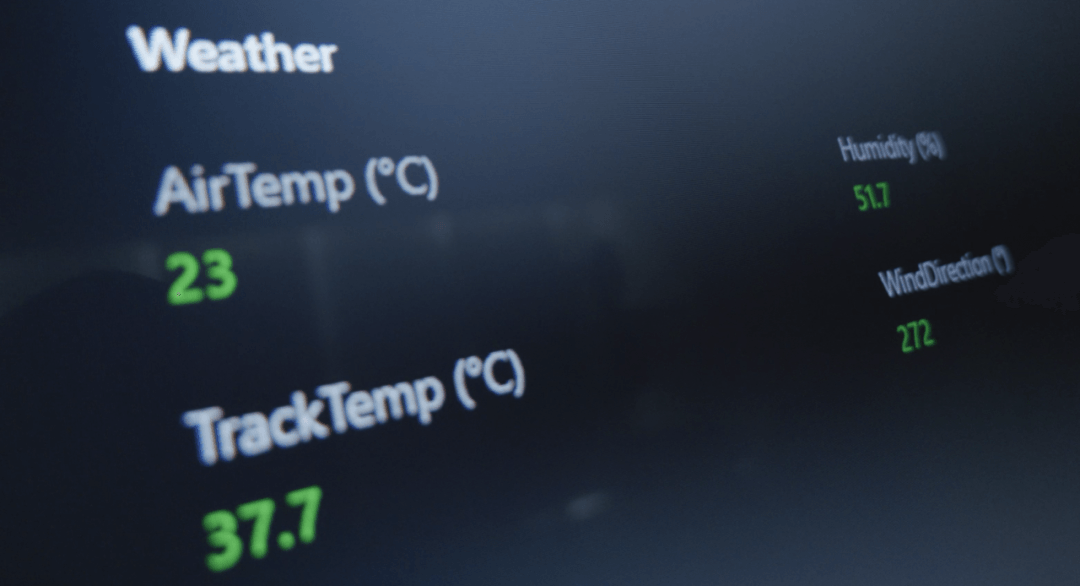
The database uses telemetry technology to transmit data from the race car to the pits and control center in real time, enabling the team to understand the car’s status instantly and formulate strategies accordingly. The massive data in racing can be broadly categorized into three types: historical data, pre-race test data, and real-time data. DolphinDB can capture and monitor vehicle sensor data, track condition data, and driver behavior data at high speed, covering everything from the car’s speed, acceleration, and steering angle to its state of charge, fuel level, oil pressure and temperature indicators, and the status of its drag reduction systems.
Real-Time Monitoring
Race car performance monitoring forms the foundation of race strategy. In the absence of interfering factors such as accidents or extreme weather, the race team relies on a series of key data to predict the optimal pit stop window. Data such as the car’s current position, lead time, fastest lap time versus current lap time, instantaneous speed, and gear status are all focal points of real-time monitoring, forming the core of strategic decision-making. Furthermore, brake and throttle usage, tire pressure, tire wear, the condition of key vehicle components, and fuel level provide a comprehensive view of the car’s real-time performance.
Data Analysis: Unearthing Value from Data
Data analysis in racing is a complex process involving a wide range of technologies and methods. It collects massive amounts of telemetry data from sensors on the race car to conduct real-time monitoring and in-depth evaluation of the vehicle’s performance. Through meticulous analysis of this data, the team can formulate precise race strategies while also evaluating and providing feedback on driver performance to optimize their driving techniques. Additionally, data analysis is used to monitor potential mechanical issues, predict the car’s performance under different conditions, and perform risk management. Comparative analysis of historical data can help the team identify long-term trends, providing guidance for future races and the development of racing technology.

The above presents some application scenarios and functional introductions of DolphinDB in the field of racing. These digital technologies employed in Formula racing are not unfamiliar in our daily lives. In connected vehicle systems, although the daily driving experience may not be as intense and thrilling as Formula racing, our ordinary vehicles also continuously generate large volumes of high-speed data streams collected by vehicle sensors. By analyzing this data, operators and managers can realize real-time vehicle monitoring, predictive maintenance, intelligent traffic management, fault diagnosis, and other scenarios, thereby improving vehicle operational efficiency, reducing maintenance costs, enhancing road safety, and promoting the development of intelligent transportation and smart cities.
Here is a review: Ten-minute verification of a high-performance connected vehicle data platform solution
In this architecture, massive data from multiple sources such as time information, latitude and longitude, speed, tire pressure, battery status, and fuel consumption enters the DolphinDB big data platform from the collection layer and is injected into streaming data tables. DolphinDB subscribes to the streaming data tables and performs associative queries with business data such as orders and vehicle configurations to achieve analysis, monitoring, and early warning. The output enters the application layer, interfacing with business systems, message middleware, or being visualized through various interfaces.
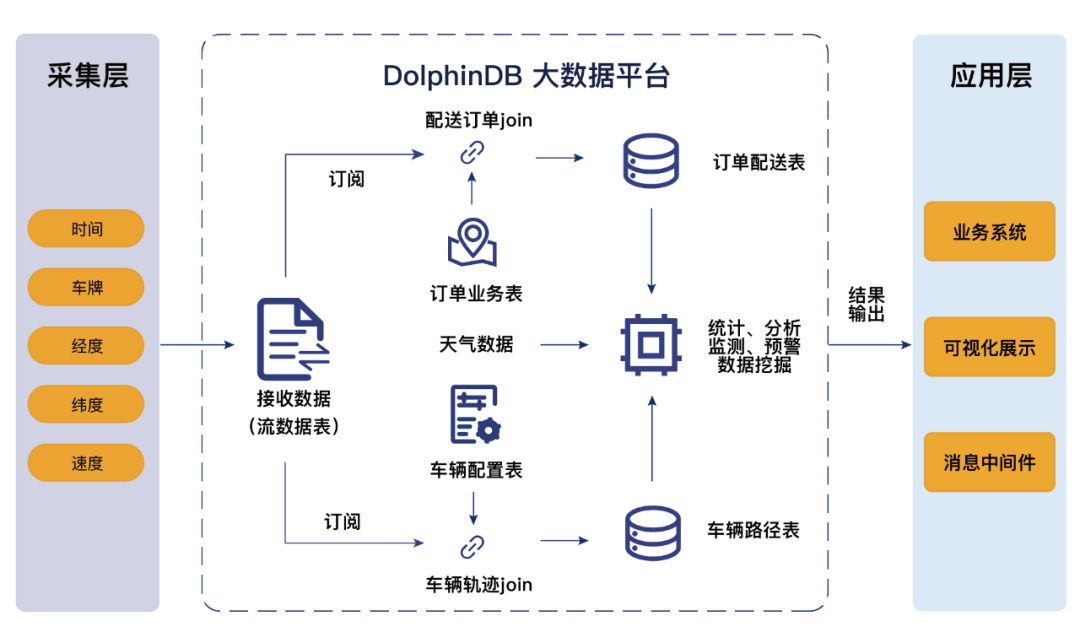
DolphinDB-based Connected Vehicle Big Data Processing Architecture Diagram
As a leader among domestic time-series databases, the solution provided by DolphinDB can not only meet the stringent requirements of Formula racing but is also widely applied in common scenarios such as connected vehicles and smart cars.
Extreme Write Speed, Multi-Model Storage
As a prerequisite for implementing data analysis, efficiently and stably receiving and writing data is crucial. Taking motorsport as an example, every action of a driver during high-speed driving, whether a precise curve or a decisive overtake, is a fleeting critical moment. At this point, if there is a delay between data feedback and visualization, it may affect the formulation of race strategy and the accuracy of real-time analysis. Similarly, in daily connected vehicle applications, when faced with anomaly detection scenarios requiring rapid response, such as vehicle faults or potential safety threats, timely warnings are paramount. This requires that the entire chain from data collection to processing to analysis must meet strict latency standards.
DolphinDB can capture sensor data in real time, directly storing it securely and efficiently into the database without the need for cumbersome secondary processing, and complete the write operation within milliseconds. After data writing is completed, DolphinDB can centrally manage various types of vehicle data, making the data easier to access and monitor. By supporting multi-model data storage, DolphinDB greatly simplifies the process of data access and monitoring. Whether conducting real-time monitoring, historical replay, or in-depth analysis, users can easily obtain the required data. Furthermore, DolphinDB provides flexible and powerful data retrieval tools, enabling users to quickly locate and extract information of interest, further enhancing the availability and practicality of the data.
Data Replay, Sharp Insights
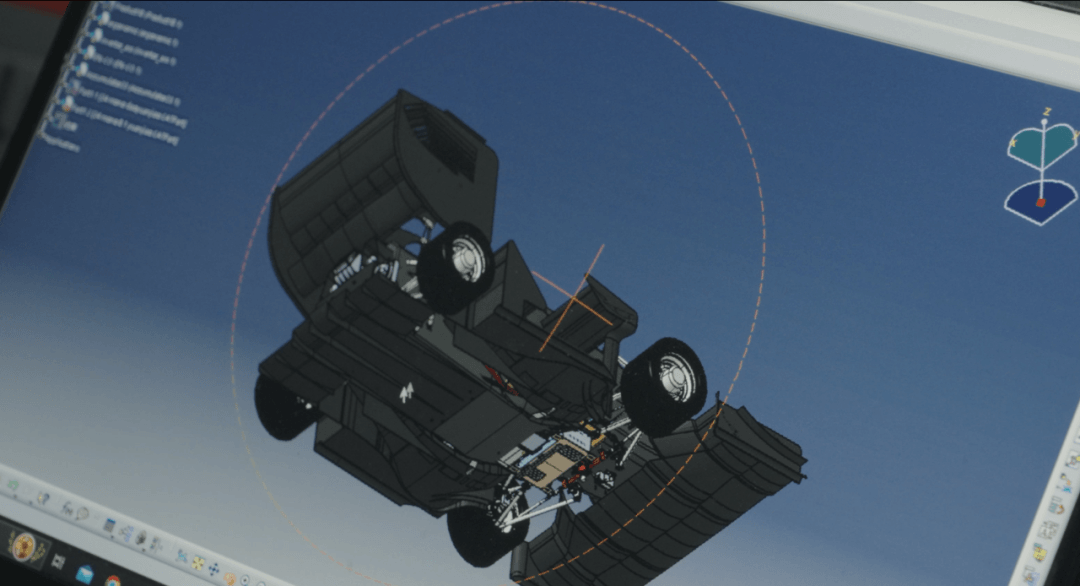
DolphinDB’s unique data replay function brings great convenience to racing teams. By customizing the replay rate, analysts can reproduce the historical behavior of the vehicle and analyze and calculate relevant indicators, delving deep into the driver’s racing strategies and accurately diagnosing potential equipment failures. This powerful data replay analysis capability provides valuable data insights and decision support for team management, helping the team continuously optimize race car performance and enhance the driver’s competitive level, thereby securing a more favorable competitive position in intense races.
The data replay function also plays a key role in connected vehicles. DolphinDB allows users to reload and analyze historical data to simulate a vehicle’s behavior and performance under specific conditions. This function is crucial for fault diagnosis, performance testing, system optimization, and data analysis verification. Through data replay, enterprises and researchers can reproduce the vehicle’s driving trajectory, sensor readings, and operational events. Additionally, data replay can be used for training and educational purposes, helping drivers become familiar with vehicle operation and monitoring systems.
Lightning-Fast Queries, Precise Analysis
Racing accumulates a large amount of historical race data. For example, during a race, drivers need to complete multiple laps, and lap time is a key metric for measuring their performance. In addition to real-time monitoring of the current lap time and predicting strategies based on it, drivers and teams also need to quickly compare the current driving performance with historical data. This usually involves three critical lap time data points: the fastest test lap time before the race, the lap time of the previous race lap, and the fastest lap time in the race so far. This comparison is crucial for real-time strategy adjustment and optimizing race car performance.

To quickly query specific lap time data and promptly respond to rapid changes during a race, DolphinDB can efficiently store and index this data, supporting fast data retrieval and querying to help analyze historical performance. Additionally, the team needs to perform pipeline analysis and processing comparing the current lap time with historical data, thereby conducting rigorous real-time comparisons and strategy adjustments. DolphinDB provides over 10 streaming computing engines and more than 1500 built-in functions, capable of processing large amounts of real-time incoming data and performing complex data transformation and aggregation operations, which are vital for real-time monitoring of the race car’s status and analyzing dynamic changes during the race. At the same time, DolphinDB offers the team powerful analysis and modeling tools that can be used to build complex data analysis models, such as prediction models and performance optimization models.
Through high-performance stream computing, DolphinDB can process large-scale, high-density real-time data streams, ensuring the immediacy and accuracy of information. Low latency enables the system to achieve real-time response, effectively enhancing the efficiency of monitoring and management. Meanwhile, the high-throughput stream computing capability can easily handle multi-source, high-frequency data input, meeting the needs of connected vehicle systems for large-scale data processing and providing the underlying architectural support for real-time monitoring of vehicle status, timely follow-up on the vehicle’s real-time condition, and driver behavior.
Real-Time Monitoring, Worry-Free Driving
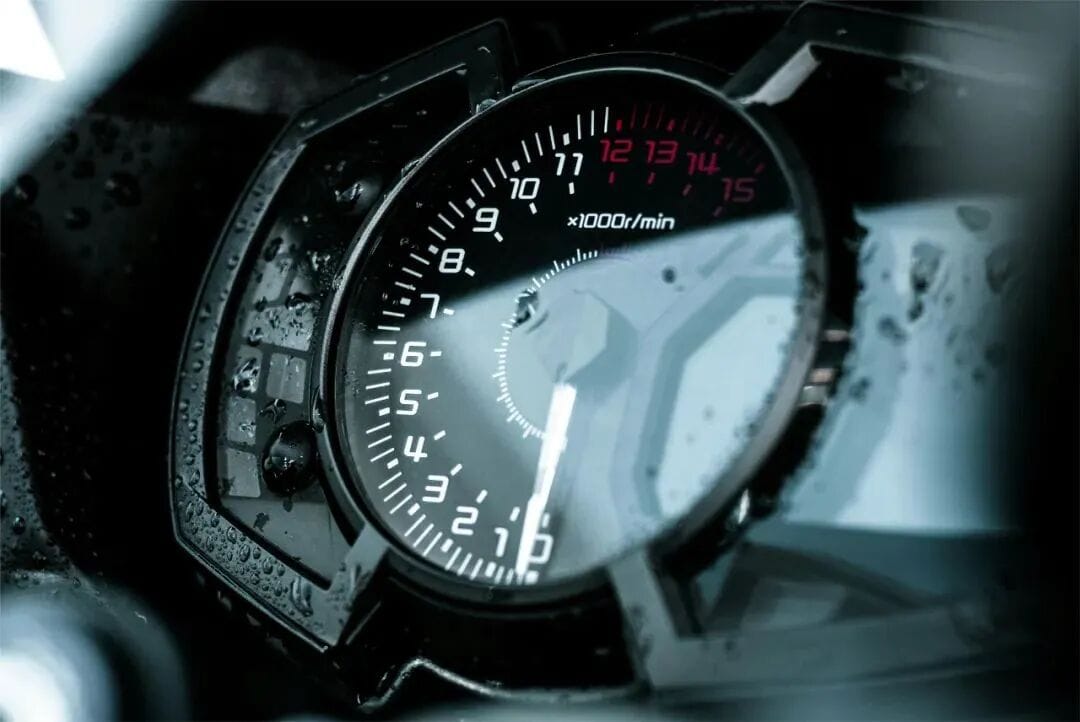
On the racetrack, every second’s dynamics can be the key to victory or defeat. With its high-performance, low-latency, high-throughput real-time data stream processing capabilities, DolphinDB provides racing teams with unprecedented real-time monitoring abilities. It can not only monitor critical parameters such as the race car’s battery temperature, motor speed, and sensor information in real time, ensuring the car operates at its best, but also rapidly issue alerts upon detecting anomalies, prompting the team to react quickly and ensuring the driver’s safety.
Similarly, DolphinDB provides an efficient data processing platform for connected vehicles, capable of receiving and analyzing vehicle sensor data instantly, thereby enabling continuous monitoring of vehicle status and performance, predicting potential failures, and reducing downtime. Its high-performance stream computing engine can efficiently process high-speed data streams from sensors, realizing real-time analysis and monitoring of vehicle status. Leveraging its powerful computing capabilities, the engine can quickly execute complex data analysis tasks such as pattern recognition, anomaly detection, and trend prediction, thereby providing support for vehicle health management, safety monitoring, and intelligent decision-making. The stream computing engine also supports real-time data aggregation, filtering, and window computation, ensuring data timeliness and accuracy.
The stream computing engine also demonstrates its powerful functionality in customizing warning indicators. It can flexibly define and implement various real-time warning indicators. By continuously monitoring and analyzing the vehicle’s operational data, DolphinDB can capture potential risks and abnormal indicators in real time, such as vehicle deviating from the intended route, speeding, or mechanical failure, and immediately trigger warning notifications. This not only improves the accuracy of vehicle status monitoring but also greatly enhances the response speed to emergencies. Furthermore, DolphinDB supports integrating warning results with third-party systems or applications, enabling cross-system linked response, thus building a comprehensive and intelligent vehicle monitoring and warning system.
Data Compression, Slimming Down Without Slowing Down
Racing generates a huge volume of data, encompassing real-time, historical, and training data, etc. Without effective compression and management, it would greatly increase the storage burden on teams. DolphinDB uses columnar storage and compression technology to optimize data storage, reduce disk I/O operations, and improve write speed. While ensuring data integrity and quality, it significantly reduces the storage space occupied by data, thereby saving the team’s hardware investment. This technology can store more data within limited storage space without affecting data processing speed. As a result, teams can more easily cope with the challenges of data growth and focus more on race car performance optimization and race strategy formulation.
Efficient data compression is especially important in the connected vehicle field. DolphinDB can significantly reduce storage requirements and network transmission burdens while maintaining data integrity and availability. DolphinDB’s distributed tables support lossless compression. Users do not need to perform additional configuration; the system automatically compresses inserted data. Users can also further increase the compression rate through specific configurations, effectively reducing storage costs, improving data transmission efficiency, and optimizing hardware resource utilization.
Flexible Partitioning, Enhanced Efficiency
In the wide application of connected vehicles, in addition to real-time monitoring and analysis of vehicle performance data, detailed management and analysis of vehicles from different regions or with different license plate numbers is also required. This involves comprehensive consideration of data across multiple dimensions such as the vehicle’s operational status, driving path, maintenance records, and usage. DolphinDB, with its outstanding data management capabilities, provides strong support for fleets. Its flexible partitioning scheme allows users to customize data partitions according to specific needs and perform targeted data analysis and optimization, thereby simplifying the data classification and management process. This not only improves the efficiency of data analysis but also enhances its pertinence and accuracy.
DolphinDB’s flexible partitioning function allows data to be efficiently organized based on key indicators such as timestamp, vehicle ID, or geographic location, thereby optimizing data storage and query performance. This partitioning strategy not only improves the ability to process real-time data but also speeds up queries by reducing the amount of data that needs to be scanned during queries. Furthermore, it supports complex SQL queries, making data analysis tasks such as vehicle behavior and traffic patterns more efficient. As the scale of connected vehicles continues to expand, DolphinDB’s partitioning function provides the necessary scalability, helping enterprises handle growing data at a lower cost.
Challenge the unknown, push the limits. This collaboration between DolphinDB and DIAN Racing not only demonstrates the perfect integration of technology and speed but also highlights both sides’ shared pursuit of and unremitting efforts towards superior performance. In the future, DolphinDB will uphold the philosophy that speed is value, continuously provide innovative data storage and analysis solutions, constantly explore abundant application scenarios for connected vehicle technology, and help motorsport achieve greater breakthroughs and leaps driven by data.
Layout | DolphinDB Yuan Zinan
Review | Zhang Zhiming
Editor in Charge | Tongji Automotive Media Center Li Shangwen
Approval | Shi Jingyuan, Sun Mengjie