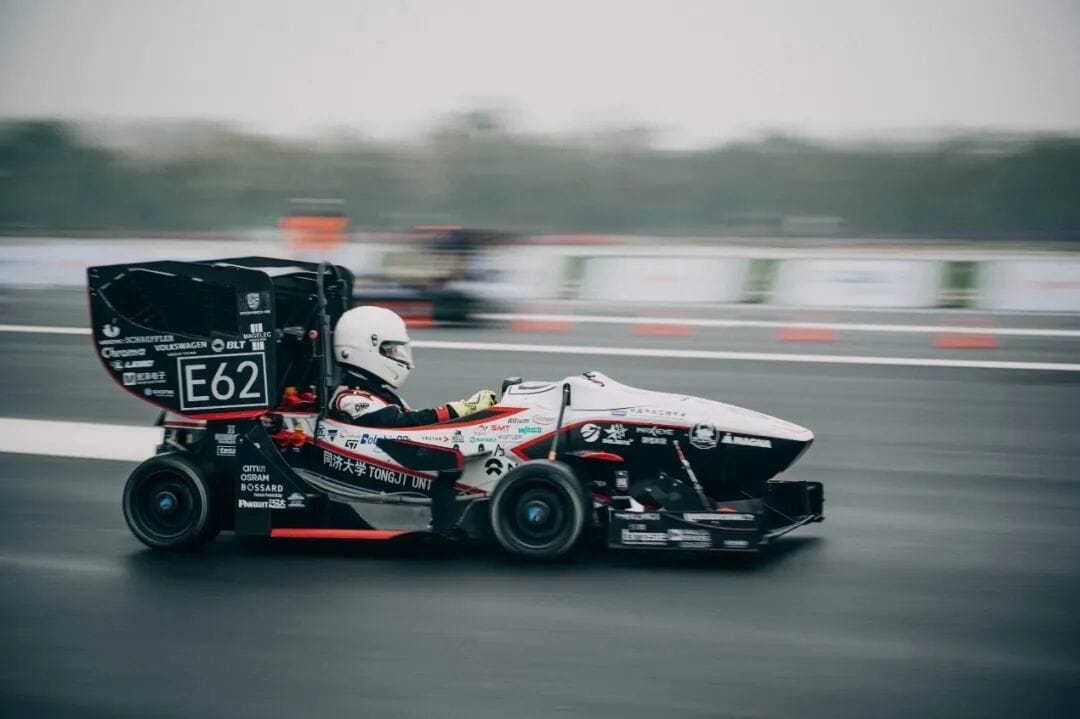
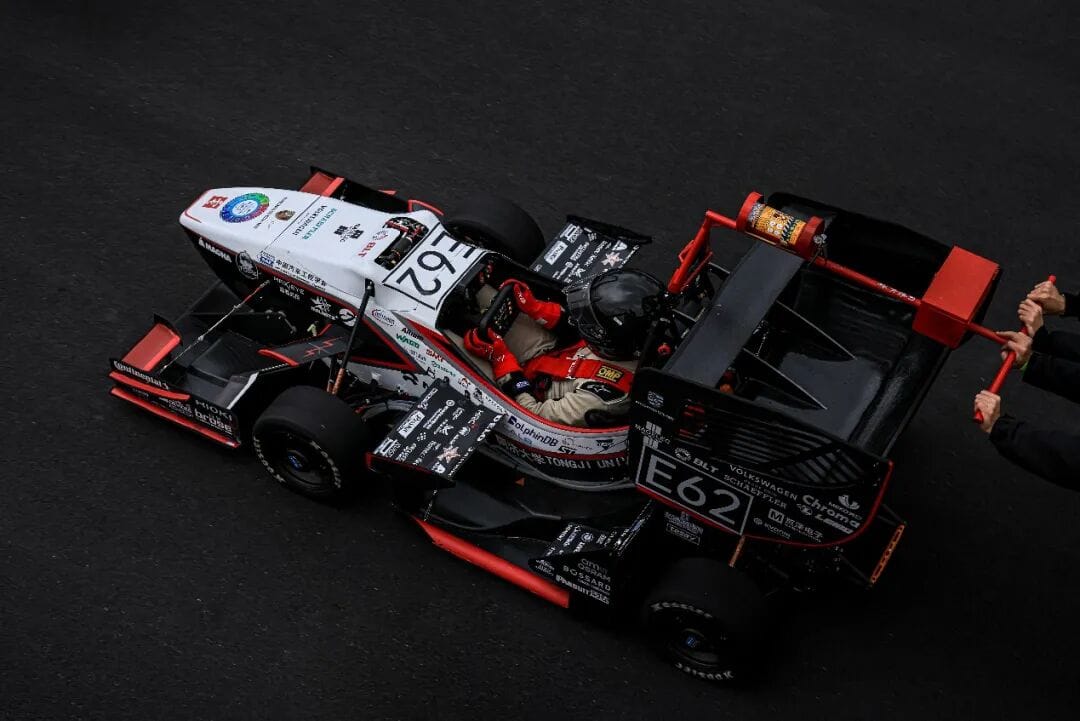
DIAN Racing Tongji University DRe23 Race Car
As a globally leading FPGA solution provider, Enclustra’s core board modules not only help numerous high-tech companies create successful products, but are also highly favored by research institutions and universities. Previously, three world-class university student racing teams in Europe chose Enclustra’s core boards, and they all achieved excellent results in top-tier global competitions. Tongji University is a national key university directly under the Ministry of Education, a national ‘Double First-Class’ construction university, and a national ‘985 Project’ and ‘211 Project’ construction university. DIAN Racing from Tongji University also chose Enclustra’s core boards and won multiple awards at the recently held FSEC 2023 competition.
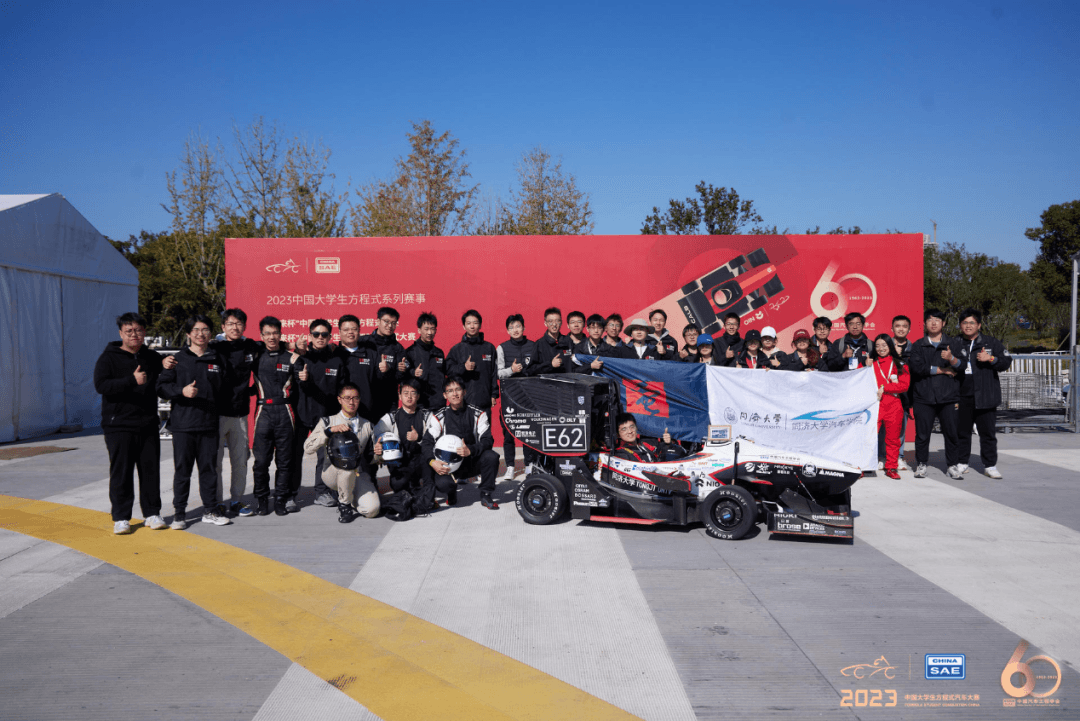
Introduction to DIAN Racing
DIAN Racing, officially the Tongji University Electric Racing Team, was founded in 2013. It is Tongji University’s Formula Student electric racing team. The team independently designs and manufactures a Formula Student electric race car each year and participates in domestic and international Formula Student electric series competitions. The team’s mission is to build a world-class racing team, participate in the FSAE series, and create a platform for exchange within the new energy vehicle industry. DIAN Racing focuses on high-specification race car design and manufacturing and efficient project management, actively participating in the World Formula Student competitions, and contributing to the promotion of new energy concepts alongside Tongji University and over 80 corporate sponsors.
At the 2023 Formula Student Electric China competition concluded last month, DIAN Racing achieved the following awards:
1st Place Design Report 1st Place Efficiency Test Outstanding Business Plan Award 3rd Place Triple Electric Technology Sharing 3rd Place MATLAB/Simulink Application Award
Race Car Powertrain System Introduction
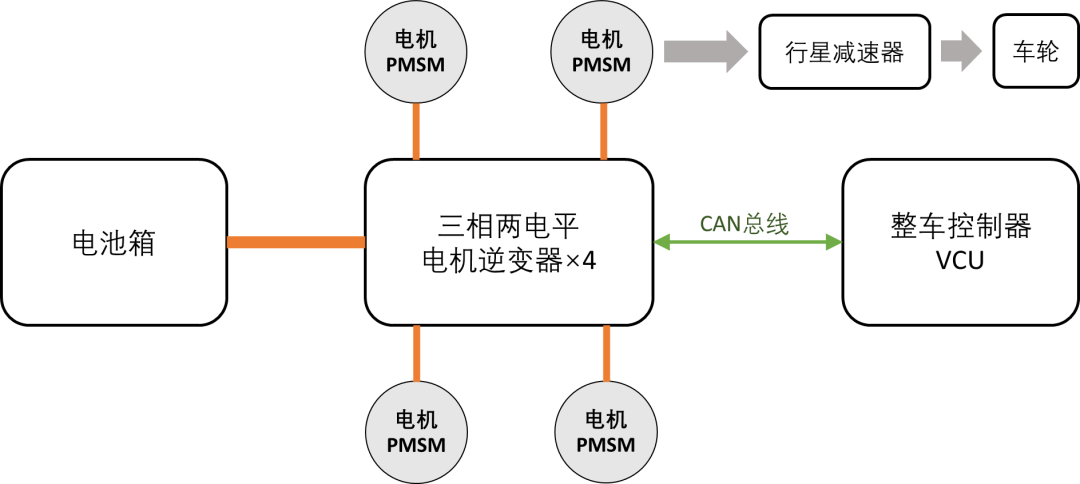
Simplified Powertrain System Block Diagram of DIAN Racing Race Car
The functional block diagram of the DIAN Racing race car’s powertrain system is shown above, including:
- Battery Pack: Power supply, a lithium-ion battery with a maximum voltage close to 600V.
- Motors: Permanent magnet synchronous motors with a maximum speed of 20,000 RPM and a peak power of 35kW, mounted next to the wheels, paired with planetary gear reducers, enabling four-wheel independent drive.
- Motor Inverters: Motor drive units that drive the motors to output corresponding torque based on commands from the Vehicle Control Unit.
- Vehicle Control Unit (VCU): Manages the vehicle, receives various sensor signals for dynamic control, calculates the optimal output torque for each wheel, and maximizes the vehicle dynamics performance of the four-wheel independent drive system.
To achieve a higher degree of race car design freedom, lightweighting, and to enhance car performance, DIAN Racing has always been committed to the independent research and development of the electric drive system. In the motor inverter project currently underway at DIAN Racing, the team uses discrete SiC MOSFET components to design the power stage and gate driver board of the inverter, and uses a microcontroller with a main frequency of 200MHz to implement the motor control algorithm. The structure and functional block diagram of this project are shown below.
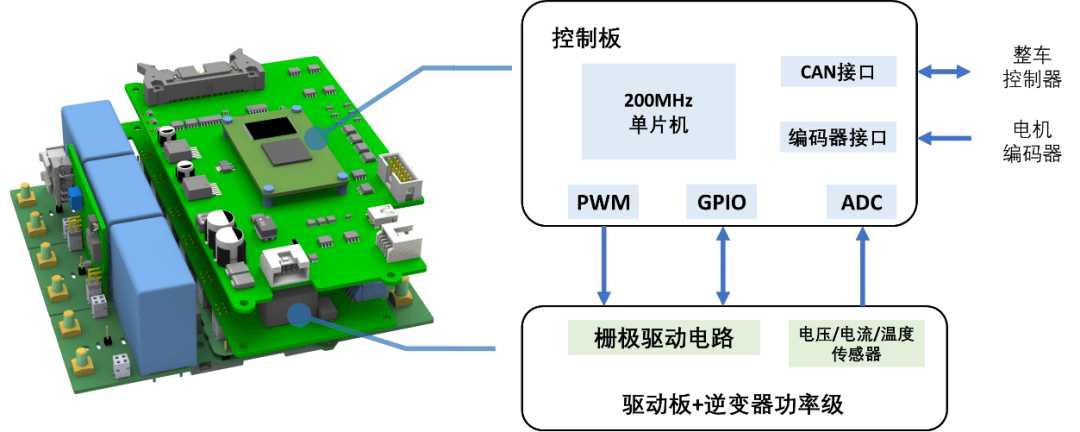
Structure and Functional Block Diagram of a Single Motor Inverter Based on Microcontroller
In the current solution, since there are four motors in total, four independent motor control boards are required, each responsible for one motor. This increases the workload for debugging and maintenance. At the same time, due to the limitations of the microcontroller’s computing performance, the team cannot significantly improve the control frequency. Therefore, the team hopes to have a powerful hardware platform for researching motor control algorithm software, capable of independently realizing the drive control of multiple motors, simplifying the system structure, possessing ample expansion capability for the future, and ideally enabling convenient online debugging, viewing, and recording of large amounts of data. Thus, DIAN Racing turned its attention from microcontrollers to FPGA SoC processors with integrated ARM cores, hoping to leverage the powerful performance and flexible application scenarios of such processors to help the team build better race cars.
Mercury XU5 Core Board
After researching and analyzing cases from top international teams and collecting information, DIAN Racing found the FPGA SoC core boards and development kits from Enclustra. DIAN Racing can easily integrate these compact core board products into the team’s systems for rapid prototyping without worrying about complex FPGA SoC peripheral circuit design. Based on the core board development kit provided by Enclustra for DIAN Racing, a sustainable development platform for use primarily in the coming years gradually took shape in the minds of the DIAN Racing team.
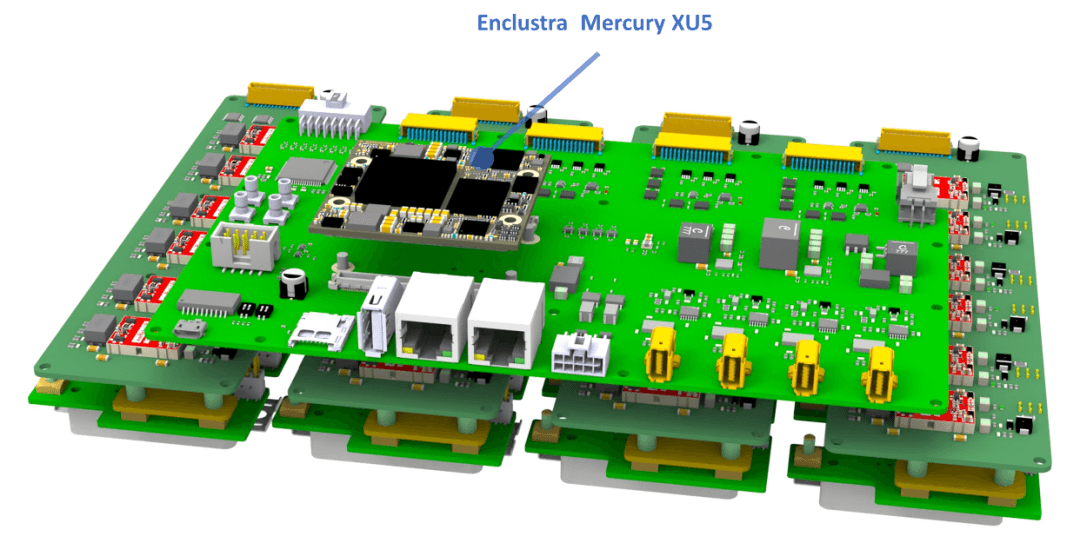
Rendering of the Motor Inverter Based on the Mercury XU5 Core Board
As shown in the figure above, DIAN Racing designed a 4-in-1 motor controller board, integrating circuits with the same functions from the original four independent control boards, and uses Enclustra’s Mercury XU5-5EV SoM as the core processing platform on the control board, simultaneously realizing the drive control of four motors.
Enclustra Mercury XU5 Core Board + ST1 Baseboard Development Kit
The PS side of the processor carried on this core board contains four ARM A53 cores as application processors, capable of running the Petalinux operating system. It has two 600MHz ARM R5 real-time cores and a high-capacity PL side. DIAN Racing can utilize its multi-in-one feature to select the appropriate processing unit for each part of the software. Considering the level of accumulated relevant knowledge and usage experience, DIAN Racing can initially choose a relatively simple and familiar software solution and continuously improve it later.
For example, in the initial stage, DIAN Racing will implement GPIO, PWM modules, interfaces for the motor resolver, current sensor interfaces, and fast fault protection on the PL side. Using the PL side, DIAN Racing can conveniently integrate multiple channels of sinc digital filters and use Σ-Δ ADCs to achieve high-quality analog-to-digital signal conversion. The motor vector control algorithm will be implemented by the R5 real-time cores on the PS side, with each R5 real-time core responsible for controlling two motors. The Petalinux operating system will run on the A53 cores to collect various intermediate signals from the motor control algorithm program and send them to a PC host computer via Gigabit Ethernet, facilitating real-time monitoring during the debugging process and also recording data on the motor controller’s operating status.
After accumulating a certain amount of knowledge and experience, DIAN Racing will also migrate the current control loop of the motor control to the PL side. Leveraging the parallel computing capability of the PL side, it is expected that the switching frequency can be increased from the current 16kHz of the microcontroller-based independent control board solution to 30kHz or even higher. One R5 real-time core will be used for the motor control state machine, fault detection, command reception, and status feedback, and communicate with the Vehicle Control Unit (VCU) via the CAN bus. It is even possible to implement the VCU on the remaining R5 real-time core, further simplifying the architecture of the car’s controllers. Simultaneously, the Linux operating system running on the A53 cores of the PS side will be used for vehicle data processing and recording, and wireless communication forwarding via the Ethernet interface, improving testing and analysis efficiency. The final expected software block diagram is shown below:
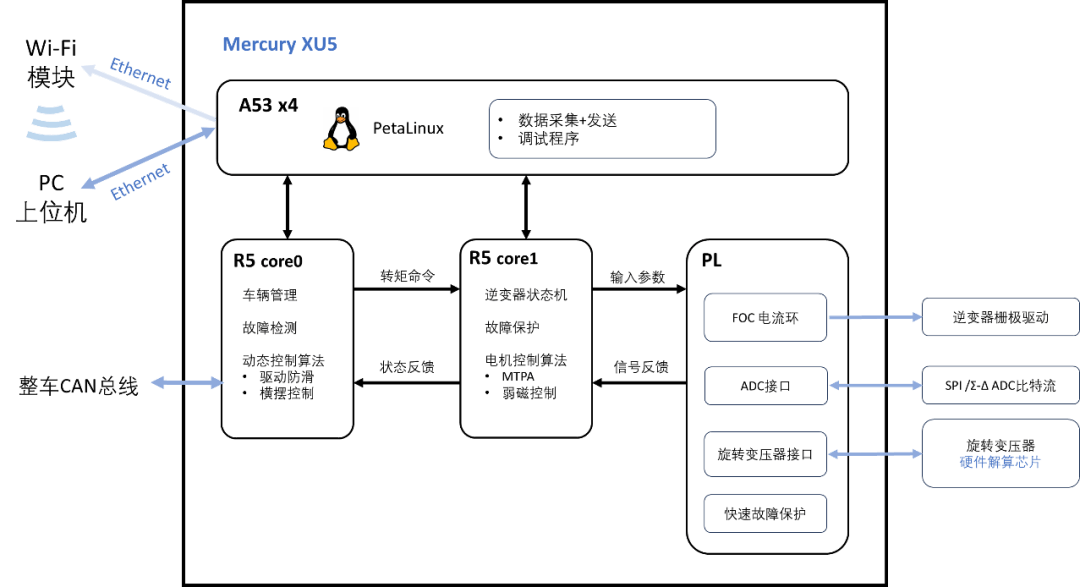
Software Block Diagram of the Motor Inverter Based on the Mercury XU5 Core Board
Currently, DIAN Racing is working on the design of the race car for the new season and will conduct more detailed development and testing verification of this system based on Enclustra’s Mercury XU5 core board. We thank DIAN Racing for their trust in and choice of Enclustra. We hope this system brings DIAN Racing a more powerful race car, serves as a platform for team members to increase their knowledge, and assists DIAN Racing in its efforts to build a first-class team.
We congratulate DIAN Racing on achieving such impressive results and wish them success in building even more successful race cars based on Enclustra products! We also wish DIAN Racing even greater brilliance on the world stage in the future!
Enclustra
Enclustra is one of the world-class companies in the FPGA field, founded in 2004 in Zurich, Switzerland. It currently has employees from 29 countries serving over 1700 corporate clients in more than 70 countries worldwide. Its success stories cover fields such as medical, communications, machine vision, image processing, aerospace, industrial control, test and measurement, and motion control, helping customers accelerate time-to-market, reduce project costs and risks, and possess stronger industry competitiveness.
Source | Enclustra Editor-in-Charge | Tongji Automotive Media Center Li Yueting Reviewer | Shi Jingyuan Liu Zhao